Graphing for Learning and Teaching
- id: 1764946663
- Date: Dec. 5, 2025, 2:58 p.m.
- Author: Donald F. Elger
- Goals
- Catalyze learning or teaching by using graphs.
- Build high quality graphs, especially for topics that are difficult to learn
- Describe graphs.
- Recognize the value of graph and become a person who routinely uses them for teaching, learning, explaining, and thinking
- Graphs (Network Diagrams)
A graph refers to a network diagram like this one
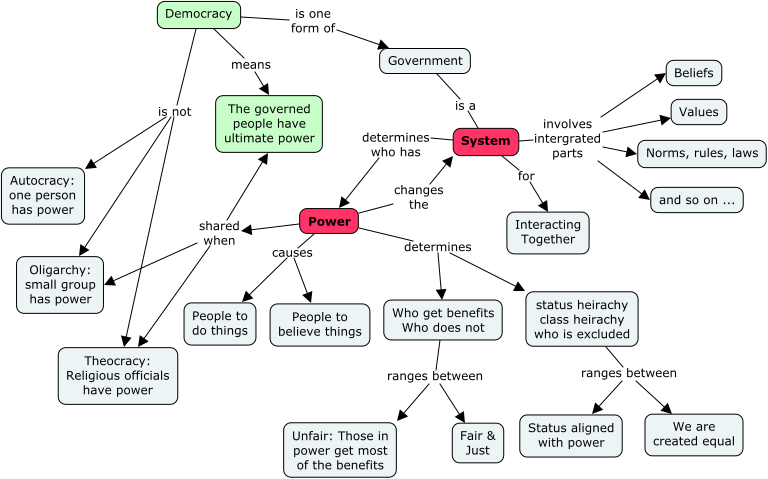
A graph also refers to a typical x-y plot like we use in math or science. But, this page refers to graphs in the context of network diagrams.
Graphs as network diagrams are taught in computer programming, math, and information technology courses.
- What
- Graphing means representing knowledge as nodes connected by relationships.
- A graph can show causes, dependencies, similarities, contrasts, interactions, and feedback loops.
- Graphs differ from lists, trees, and tables because they show many-to-many relationships instead of one-to-many.
- This makes graphs ideal for topics that are complex, interconnected, or hard to grok.
- Core idea: Graphing works because it is the natural language of the brain. When you graph, you stop fighting how the brain organizes knowledge and start working with it.
- Why
- The brain stores knowledge as a network of connected ideas.
- Nodes are concepts.
- Edges are associations and relationships.
- Graphs mirror how neural networks represent meaning, so learning feels more natural and less effortful.
- Graphs reduce cognitive load by offloading structure from working memory onto the page.
- Graphs increase understanding by showing the deep relationships that lists and trees cannot capture.
- Graphs support better recall by creating many retrieval paths for each idea.
- Graphs help detect:
- Missing ideas
- Contradictions
- Weak connections
- Misconceptions
- Graphs support meaningful learning, not just memorization.
- The brain stores knowledge as a network of connected ideas.
- How to Excel
- Start with a topic you want to understand or teach.
- Identify the key concepts.
- Place concepts as nodes.
- Draw arrows to show relationships.
- causes
- depends on
- interacts with
- contrasts with
- leads to
- consists of
- Add linking phrases to make relationships explicit.
- Expand outward to reveal the full structure of the idea.
- Check for clarity:
- Does each node represent a clear idea?
- Is each relationship accurate and meaningful?
- Are important interactions missing?
- Are any relationships ambiguous or vague?
- Revise the graph until the structure feels obvious and intuitive.
- Use the graph for explanation, teaching, or further learning.
- Examples of When to Use Graphs
- Understanding systems
- ecosystems
- democracies
- economies
- Understanding processes
- chemical reactions
- feedback loops
- learning models
- Understanding complex concepts
- power
- motivation
- fairness
- Mapping relationships across many categories
- beliefs, norms, values
- causes and consequences
- evidence and conclusions
- Understanding systems
- Summary
- Graphs align with the brain’s natural architecture.
- They externalize the hidden structure of understanding.
- They reveal relationships that linear formats hide.
- They reduce cognitive load and deepen comprehension.
- They turn information into meaning.
- When you graph, you work with the brain instead of against it.